Showing posts with label MP3 blogs. Show all posts

Monday, March 23, 2009

They Finally Got Me: My First DMCA Takedown Notice


Well, after 15 months of no hassle, I've received my first DMCA takedown notice from Blogger. Of course, the offending post has already been taken down by Blogger, so it's more of a notice to tell you it's gone rather than a notice to tell you to take it down. The post that was deleted was a weekly mix from last August, long dead links and all. Even more bizarrely, this mix featured only cover versions and many of them were by artists that I've featured several times over. I know this because I took precautions several months ago and saved all of my previous posts to a Word document. At this point, all of these details aren't even important. The real issue is one that I've talked about ad nauseum before. It's frustrating because my own arguments and those of other intelligent people don't have any effect. It's the same reason I felt frustrated when I went to see RiP: A Remixer's Manifesto yesterday.

The Brett Gaylor documentary was fantastic, but it essentially said everything I've already been thinking and discussing with others for the past few years. According to the film, the Remixer's Manifesto is thus:

1. Culture always builds on the past.
2. The past always tries to control the future.
3. Our future is becoming less free.
4. To build free societies you must limit the control of the past.

There were some really brilliant juxtapositions in the film as Gaylor demonstrates his points (one of my favourites was how he traces the use and/or evolution of a traditional folk/blues song/hook, The Last Time, through The Rolling Stones, The Verve and ultimately to its use by Girl Talk - the point being only The Rolling Stones did the suing within this process despite the fact they weren't the original authors either). In the end, the process of the film is more important than its end product (Eno, anyone?), and the style of the documentary itself proves its point about remixing art and culture to provoke new ideas and enjoyment; without building on the past, progress is stifled and stagnant. Gaylor draws the battle lines clearly: you're either on the Copy Right or the Copy Left, you're either stuck in the past or looking to the future. He even put up his raw footage online to allow others to participate in an open source way. Oddly enough, Stanford law professor, Lawrence Lessig said things in the documentary that I wrote in that older post nearly verbatim, most particularly in the area of not being able to create in a vacuum and in his using the example of citations in essays and books. But neither of us owns the "right" to those thoughts.

With the advent of the Internet, the public domain has grown infinitely and beyond the conservative, stunted thinking of those in power. Trying to lock people up and shut them down will continue to be a futile exercise. I know I'm not doing anything wrong, yet having my own "intellectual property" deleted without my permission is legally sound because Google, a $31 billion company, owns Blogger, my current blog host. Talk about media control and strangle holds. How do you google Google? It's the philosophical question of the Noughties. What kind of information are you going to get about the company when they're the primary method for your search?

Here's the notice I received today:

Blogger has been notified, according to the terms of the Digital Millennium Copyright Act (DMCA), that certain content in your blog infringes upon the copyrights of others. The URL(s) of the allegedly infringing post(s) may be found at the end of this message.

The notice that we received from the International Federation of the Phonographic Industry (IFPI) and the record companies it represents, with any personally identifying information removed, will be posted online by a service called Chilling Effects at http://www.chillingeffects.org. We do this in accordance with the Digital Millennium Copyright Act (DMCA). Please note that it may take Chilling Effects up to several weeks to post the notice online at the link provided.

The IFPI is a trade association that represents over 1,400 major and independent record companies in the US and internationally who create, manufacture and distribute sound recordings (the "IFPI Represented Companies").

The DMCA is a United States copyright law that provides guidelines for online service provider liability in case of copyright infringement. We are in the process of removing from our servers the links that allegedly infringe upon the copyrights of others. If we did not do so, we would be subject to a claim of copyright infringement, regardless of its merits. See http://www.educause.edu/Browse/645?PARENT_ID=254 for more information about the DMCA, and see http://www.google.com/dmca.html for the process that Blogger requires in order to make a DMCA complaint.

Blogger can reinstate these posts upon receipt of a counter notification pursuant to sections 512(g)(2) and 3) of the DMCA. For more information about the requirements of a counter notification and a link to a sample counter notification, see http://www.google.com/dmca.html#counter. Please note that repeated violations to our Terms of Service may result in further remedial action taken against your Blogger account. If you have legal questions about this notification, you should retain your own legal counsel. If you have any other questions about this notification, please let us know.

Sincerely,
The Blogger Team


My favourite bit is the part "regardless of its merits."

I refuse to be intimidated (in many ways, what Blogger is doing is like someone breaking into your apartment and stealing your possessions - and it's not even like I'm keeping my door locked, so to speak), and I'm not going to sit back and let them slowly dismantle my free speech in the "public" domain. So, CTRR is moving house as soon as possible. I don't care how much work it will be to get this blog back up on my own and on my own terms. Bear with me while I plant my flag in the Copy Left. I'll keep you posted.

Don't Stop - Girl Talk

We're Not Gonna Take It - Twisted Sister

Saturday, November 1, 2008

Read All About It


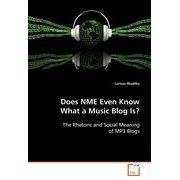
Through life's strange twists and online accessibility, my MA thesis, Does NME Even Know What a Music Blog Is?: The Rhetoric and Social Meaning of MP3 Blogs (see earlier post), is now available as a book published by VDM Publishing. That's the good news. The perhaps not-as-good news is the fact it is priced at $64 US - I have officially become a part of the artificially inflated academic book market. Currently, the only place where it actually appears to be in stock is on Amazon US and Target, and is listed, but not yet in stock on Amazon UK and Amazon Germany. I definitely don't intend to get rich from this, but at least it feels like I didn't sacrifice a chunk of my sanity for nothing, and I still feel the current technological climate of the music industry and its counterpart of music journalism is a fascinating area that needs far more exploration, academic and otherwise. It's exciting to think that I've contributed in some way to this global dialogue, especially since I couldn't find any secondary academic sources about MP3 blogs when I was researching. It's funny how, as a child, I always imagined my first published book would be a novel - then again, I also thought I'd grow up to be both a scientist and an artist.

At any rate, this will likely be the first and last time you'll find me tooting my own horn, so to speak. I'd much rather promote other people, which I suppose I did inadvertently in the book as I used numerous examples from MP3 blogs and their aggregators. However, as I tended to argue in the book, promoting others really comes down to some sort of self-promotion anyway. I'm ready to go back to the more imperceptible kind.

Monday, October 27, 2008

Sound the Last Post, Then Unite and Take Over


I, like many MP3 bloggers, am deeply disturbed by the information gathered on a post over at The Vinyl Villain. JC has collected links to the following posts that all address the current censorship and bullying that is taking place in the MP3 blogosphere:

To Die By Your Side Post
Song, By Toad Post
Teenage Kicks Post
17 Seconds Post

I encourage you to read them all because each of them provides a slightly different insight into the rash of MP3 blog post removals, specifically by Google's Blogger. I would also like to add a couple of my own links to relevant stories, including this story about Metallica and the Muxtape story. Now, as many of you know, I've been studying MP3 blogging with a fair amount of depth this past year, and as far as I could tell, most MP3 bloggers appeared safe from legal action because of the ephemeral nature of most download links, because of their disclaimers about asking for removal of MP3s, and because of the fact that as long as they posted only a few MP3s, and not full albums, they were operating under the following "fair use" clause of the Copyright Law:

"Notwithstanding the provisions of sections 106 and 106A, the fair use of a copyrighted work, including such use by reproduction in copies or phonorecords or by any other means specified by that section, for purposes such as criticism, comment, news reporting, teaching (including multiple copies for classroom use), scholarship, or research, is not an infringement of copyright. In determining whether the use made of a work in any particular case is a fair use the factors to be considered shall include—

(1) the purpose and character of the use, including whether such use is of a commercial nature or is for nonprofit educational purposes;

(2) the nature of the copyrighted work;

(3) the amount and substantiality of the portion used in relation to the copyrighted work as a whole; and

(4) the effect of the use upon the potential market for or value of the copyrighted work.

The fact that a work is unpublished shall not itself bar a finding of fair use if such finding is made upon consideration of all the above factors."

As evident through the above bloggers' stories, this safety net has been torn from under us. Now there are talks of blogs disappearing and/or going underground (ie: email subscription services), but what I fail to understand is what record labels hope to gain by attacking MP3 blogs. Have they heard of torrents? Is it because it's easier to target a bunch of relatively small static entities rather than massive networks whirling around the globe? To treat MP3 blogs and their offshoots as though they're the same as the P2P filesharing frenzy started by Napster in the late 90s, is utterly ridiculous. There are so many flaws in these actions on the part of both major record labels and Google, but I would like to point out a few pertinent ones.

Firstly, how can archaic copyright laws be applied to drastically new developments in technology? How can you steal something whilst leaving it with the person you "stole" it from? This process is one of cloning, not of physical products leaving one spatial location to be in another. And after being in academia so long, I know the copyright law well enough - of course you can't photocopy a whole book, but you can definitely copy portions that you need for your studies. The reason why this analogy doesn't quite work is because photocopying a book would be a lot more time-consuming than downloading and burning an album or several. But I would like to point out the fact that research and epistemological processes have been built upon the foundation of citation. You cannot write an academic piece of literature without references, citations and examples from previous works to bolster your argument. Well, MP3s are bolstering our arguments. We are not plagiarizing entire books, we are providing our examples. Consider our MP3 links to be inside quotation marks.

Ideas and art do not spring from a vacuum. This is the civilized world that literacy ushered in. Once thoughts and information could be recorded for reference, they could be easily used to continue building on, generating a sense of progress. Science and technology themselves couldn't have gone anywhere without the free flow and dissemination of information. Knowledge generates knowledge, and by preventing access to ideas and cultural artifacts, big businesses are only killing civilization as we know it. However, when you take a look at the history of communication, we are merely repeating it. When the printing press became more widespread, copyright laws were created by those that feared losing power, and restrictions were placed on who could produce printed news and books, but eventually, progress broke the elitist hold and the presses were opened again. This is not to say that censorship isn't alive and well and that "free" societies are actually completely free and democratic.

In the current state of the world, it is becoming increasingly apparent that information is the new power, not military. Wars shall be fought with information and gathered intelligence - knowledge is indeed power. Chomsky and Herman's Propaganda Model makes the point that journalism is greatly shaped and filtered by restricting means of production and communication to only those who have the financial means to do so. These filters are firmly entrenched in the world of journalism, so much so that they tend to be invisible to most people. I suggest you read Manufacturing Consent to illuminate this fraudulent concept of freedom of speech. My worry is how these filters will eventually find their way from the world of "official" journalism to the world of "unofficial" journalism. In some ways, they already have. For those without the money for a computer or high-speed Internet, MP3 blogging wouldn't be an option in the first place. But soon the privileged, but non-elite people who maintain MP3 blogs could be silenced, too. If more of the financial elite get control over the Internet and its applications, the supposed freedom of online communcation and creation will completely disappear. My only hope is that there will continually be innovative people one step ahead, using their individual brains and sources of knowledge.

The issue here is primarily MP3s - I highly doubt blogs that merely discuss music without free downloads are being targeted in the same way. In many ways, MP3s are art, but they are also literally encoded information, so by stopping bloggers from using a few samples, music labels are obstructing the flow of information and attempting to curtail individuals thinking for themselves. Music fans are gaining power through being able to sample before buying, so record labels need only fear if their artists aren't good enough to convince people to purchase their product. It's hard to believe that the people in charge of the music industry have any business acumen at all with the absurd strategies they're using. These strategies include the hidden Copyrighting Board Private Copying Tariff on the prices of blank audio cassettes and blank CDRs.

Secondly, it seems mad that record labels haven't learned from their first go-round in which they fought the very technology that affected the future of their industry/commodity. Now, they're fighting the future of music publicity. It's like reaching for the bail bucket on the Titanic. The removal of MP3 blog posts is a pyrrhic victory for the music industry and a classic case of the music industry gnawing on the hand that feeds it. To attack people who have provided disclaimers and expired links, is an exercise in futility and ends up infringing on the property of others. And these others are the "real" music fans -the ones who actually buy music and go to live shows as opposed to the casual music fans who don't care whether they get all their music from torrents and who will likely never be the target market for excessive music buying.

It appears that Coxon of To Die By Your Side could have been targeted because he wrote a critical review of Cold War Kids' latest album. Well, I did, too - here. And perhaps one of the reasons I haven't had my post removed yet is because I'm still flying under the radar and not generating huge traffic. I, like most other bloggers, have had plenty of positive feedback from the artists themselves, who are happy that their art is being exposed to the public by people who are just as passionate about it as they are. Unlike the music industry, and to an increasingly greater extent, the music journalism industry, many MP3 bloggers view music as art, not as strictly a commodity. If the music industry is so in tune with the laws of capitalism, they should recognize the moment when a business has to adapt or die - that moment has already come and gone, but the industry has found no viable solution for itself; thus, industry people busy themselves by bullying those that can't feasibly fight back so that they can feel proactive rather than the lumbering retroactive people they are.

Fear generates fear. The obsolete middlemen in the music industry are fearing for their livelihoods, and are thus using fear tactics upon both blog hosts like Google and MP3 bloggers. I refuse to be fearful. If and when it comes to sounding my last post, I, along with other music fans, will find a new way of communicating because the process that literacy set in motion cannot be stopped. If we are to be viewed as shoplifters, then all I have to say is: Shoplifters of the world unite and take over.


Shoplifters Of the World Unite - The Smiths

Can the Haves Use Their Brains - McCarthy

Thursday, September 11, 2008

Does NME even know what a music blog is?: The rhetoric and social meaning of MP3 blogs


Well, here's the fruit of my four hardcore months of labour: my MA thesis on MP3 blogs. I had a few qualms about posting it here for download, not for intellectual property rights (because that would be rather ironic given the content of the thesis), but because I still feel there's so much more to be done and I know I could potentially have more reactions and responses than I can handle. For those who download and read it, bear in mind, I needed to make an argument of some sort, so I can understand there will be counterarguments and/or disputes with what I came up with, especially from those bloggers who have far more experience in the actual act of blogging than I do. Having said that, I will appreciate any and all comments and criticisms (unless of course you all pick up your pitchforks and run me out of the blogosphere). At any rate, it seems the powers that be have signed off on this thesis (thankfully, without any requests for revisions), and I think I'm in the clear to graduate with my MA degree. What comes next is anyone's guess...

Does NME even know what a music blog is?: The rhetoric and social meaning of MP3 blogs (Megaupload)

And some song treats to help the academia go down:

College - Johnny Boy

A Strange Education - The Cinematics

Saturday, August 9, 2008

MP3 Blogs vs Music Blogs: Part II


Largely unbeknownst to me, it seems my last, rather informal, post on the differences between music blogs with MP3s and those without became a wee bit of a meme (let's put it this way - I got far more mentions on other blogs, feeds and sites than I ever had before and would ever had expected from my cobwebby corner of cyberspace). Now that my MA thesis on MP3 blogs' rhetoric and social meaning is finished, and now that I've thought myself into a nervous breakdown of sorts, I have a few more opinions about this topic that I came to while finishing the behemoth.

Before I explore my own arguments a little further, I would like to address a few different opinions that seemed to emerge in reaction to my earlier post. Firstly, I found a post from incidentals and accidentals, which took issue with the fact I said posting music that you didn't like would be a waste of time, especially for those who write music blogs for a hobby. This blogger's exact words were:

This is the line of thinking that always really burns me. All the kvetching about the sheeplike tendencies of mp3 blogs is precisely related to the fact that so many bloggers think it’s a waste of time to talk about stuff they don’t like. More specifically, to articulate why something isn’t good, beyond a mere “this sucks” lobbed into a comments box or message board. It’s not a waste of time, particularly if you value the fact that people are regularly reading your blog. Dislikes give shape to likes. The fact that someone might be able to explain why they think one artist is shit might add weight to an argument for another artist’s strengths. I’m not saying you have to get into compare-and-contrast lists, but regular readers will grow to know and trust your tastes.

Oh and the whole thing about text-heavy bloggers being largely professional critics - Personally I’m an exception to that idea, and I know there are plenty of other exceptions as well. Again it just goes to this whole idea of people not wanting blogging to be “a waste of time” - as if one can’t write seriously about music for fun, sans paycheck. That is the hobby! Putting an mp3 online is not a hobby, it’s an impulse.

This is an interesting point - dislikes do throw your likes into relief. Perhaps to clarify my "waste of time" comment, I could argue that posting MP3s of music you hate seems counterintuitive ("Please take the time to download and listen to this song that I just provided a solid argument against listening to"). I'll be looking into the significance of MP3s as a medium later in this post. However, just as I can't assume that everyone writes positively about music (which I don't), no one else can assume that bloggers should write some negative reviews, or in fact, that they all do. I've come across many blogs who do either or both, showing that time and time again, MP3 blogs cannot be lumped together into one general genre of media. It's pretty much impossible to make any generalizing statement at all - the same blog can be different things between different posts. Like this blogger from incidentals and accidentals says, there are too many exceptions. There is also an implication in this blogger's argument that a certain type of MP3 blog is more valuable and "truer" to the genre than others, these "others" being those who just post MP3s rather than write text-heavy opinions or criticism; that those who just post MP3s are less thoughtful, less perceptive, and somehow acting on a lower, more instinctual level than one of higher, intellectual deliberation. This implication points once again to purpose, which I will get to shortly.

I also had a couple of interesting comments left on the post itself, one of which provided a link to Nevver, an MP3 blog which just posts photos and MP3s without any text, implying rather than explicitly stating connections between the two forms of art. This example takes MP3 blogs to their extreme conclusion, where words are no longer necessary. Another comment was also very helpful in that it drew a line between MP3 blogs being the new radio whilst music blogs are discussion and opinion, comparing MP3 bloggers to DJs. Together, these comments really got me thinking about why people create and maintain MP3 blogs, and the connection between how they do it and why they do it.

Now, after sorting out some rather ridiculous Kenneth Burke Dramatistic ratios about MP3 blog rhetoric, I learned a few things. The most significant one is that MP3 blogs are in no way a cohesive body with the same purposes; these purposes, however, do vary depending on which media the MP3 blogger favours to remediate, in other words, the agency he/she utilizes to convey his/her purpose and act. But how does the purpose affect the choice of agency? Or is it the other way around with the agency affecting the purpose, and then the act itself? I'm inclined to believe and argue the latter.

Let me track back a bit to remediation, which is how a medium re-uses and re-interprets a different medium. Remediation can work backwards and forwards, meaning that television is a remediation of film, which came before it, but it can also increasingly be seen in terms of interactivity, as a remediation of the Internet, which came after television. I see MP3 blogs as a remediation of the diary, music journalism/criticism, fanzine, pirate/alternative radio, and mixtape. These are the media, with their attendant purposes, that shape the purposes of MP3 blogs.

The diary element of MP3 blogs affects the purpose by making it personal and reinforcing the affective relationship between the blogger and the music he/she is writing about. This diary remediation shifts commentary into a subjective rather than objective direction, and serves to highlight the newer development of blurring between public and private, which combines self-disclosure with self-promotion. The self-promotion characteristic innate in blogs, evidenced by site traffic meters and inclusion on aggregators, is one that can gain a lot of criticism, especially when traffic and attention becomes the primary motive; however, this attitude presupposes that MP3 blogs as a genre should be something purer of motive, where only the music matters, which is an assumption that ignores the inherent and inherited diary element remediated in the blog medium. Even if one doesn't believe they're promoting him/herself along with the music featured, the very fact the blog is made public and that there is the concern for appearing trustworthy and credible, including having enough subcultural capital, makes the MP3 blog a site of self-promotion.

The music journalism/criticism remediation is one on which those who believe in an MP3 blog revolution would depend. With the access that the Internet brings, amateur writers can research and publish their own pieces about music. It is too simple to say that MP3 blogs have replaced or will replace traditional music journalism, and the fact this remediation is also bound up with public relations/promotional remediation and self-promotion makes it less clear-cut a substitution. The fanzine remediation is connected to the rather positive impulse of celebrating and promoting music that one loves, which I mentioned in the earlier post, and to a more subcultural purpose, supposedly working against and in spite of the mainstream media, promoting artists who don't get promotion through mainstream channels. However, it is also too simplistic to think that MP3 blogs are actually sticking it to the man, even if their rhetoric says they are. The symbiosis of mainstream media and subcultural media is too much a part of subculture as a concept for MP3 blogs to exist in an alternative vacuum, shunning all mainstream media. Even in defining oneself against mainstream media (ie: criticizing NME in a post), one uses and depends on the mainstream for identity and position.

The remediation of the aural media of radio and mixtape is very signficant in that it brings collection, selection, and organization into the foreground of MP3 blog purpose rather than commentary and opinion. Like DJs and mixtape makers, MP3 bloggers attribute meaning to which music they collect and then to how they present it, often without text. While the radio remediation allows for brief background and commentary about tracks (as opposed to lengthy criticism and commentary), the mixtape remediation actually offers music to blog vistors like a word-of-mouth gift - the receiver not only gets to listen to it, but gets to keep it. The mixtape remediation is pervasive in both MP3 blog content and the musical end of the Internet, including sites like Muxtape and technology like Mixas, emphasizing the fanatical impulse for collection, selection, and arrangement along with love and passion for music as motive. Ultimately, MP3 blogs are a bricolage of media that came before them, making them rather slippery to define as a genre.

While it becomes difficult to classify MP3 blogs as a genre based on purpose, the one aspect that does hold the genre together is the MP3s themselves. Regularly posting MP3s on your blog simply makes your blog an MP3 blog. MP3s themselves are fundamental to the medium of MP3 blogs. To get all McLuhan on you, "the medium is the message," and in this case, the MP3 is largely the message. In the Burkean sense, if every selection of reality is both a reflection and a deflection, making most statements, textual or not, rhetorical and/or persuasive, then the mere selection that MP3 blogs employ by choosing the MP3s they feature for download automatically deflects other choices, implying preference and value to music without having to explicitly state anything negative. Or positive. Or to state anything at all. The very act of selection is persuasive, and is made even more salient by the fact MP3 files are included. In this way, MP3s speak and argue for themselves just as other non-verbal elements like images can. Furthermore, blogs, which are of course actually "web logs," have an inherent filter/selection function in which hyperlinks act as both evidence and a record of "pre-surfed" and pre-approved information. Rather than convince by authority and "unquestionable" sources alone, which journalists and critics depend on, bloggers convince by providing a way for their readers to participate in the information they consume, assuming a more active role. With this in mind, MP3s are the primary links provided in MP3 blogs, providing support for the blogger's claims, and their very existence argues for pre-approved content.

Ultimately, MP3 blog influence is far less than many bloggers would believe it is or like it to be. While aggregators like The Hype Machine and Elbows do collect and reify disparate blogs, giving the impression of power and solidarity, they do not set the agendas as much as they would imply. For the most part, the most popular MP3 blogs are reactive rather than proactive in music selection. Unless more bloggers actually exclusively search out new, mostly unsigned, artists and collectively promote them to the point they "break" into the consciousness of those outside of the music blogosphere, they cannot be said to have all that much power to change the system already in place.

We cannot herald the MP3 blog as the substitute for music journalism/criticism, nor for radio, because in remediation, it is much more and much less depending on which aspects are focused upon. For as many people as have access to the Internet there are as many opinions, especially about what MP3 blogs should be, and more importantly, what they should do. I fully acknowledge this plurality, and whether bloggers use MP3 blogs to criticize, to promote, to share, or to express themselves, they are collectively an organism still growing and changing. And since the Internet is a fickle medium, turning attention into one of the rarest commodities, all MP3 bloggers can hope for is their slice of a fragmented, but loyal audience that believes in the purpose presented. Whatever purpose that may be. I, for one, am still thinking about it.