Showing posts with label book. Show all posts

Tuesday, March 10, 2009

The Beauty of Burning the Box of Beautiful Things: Michael Bracewell's Re-Make/Re-Model


I've read a fair amount of band/artist biographies with varying amounts of interest(oddly enough, as much as I love the band Pulp, their 400-page biography by Mark Sturdy was one of the hardest to conquer). I stumbled upon Michael Bracewell's 2007 biography of Roxy Music, Re-Make/Re-Model: Becoming Roxy Music, by accident while looking for other Michael Bracewell books. You see, I quite like Bracewell's ideas and style; I've read both England is Mine: Pop Life in Albion from Wilde to Goldie and When Surface Was Depth: Death by Cappuccino and Other Reflections on Music and Culture in the 1990's, which both gave me fascinating intertextual insights into popular culture from vastly different angles. The former probes various aspects of Englishness from arcadia to suburbia via John Betjeman, Lindsay Anderson films and The Cure while the latter discussed the atmosphere of the 90s, including a shift from irony to "authenticity" and the gentrification of the avant-garde, and explored topics from Britpop to Howard Devoto to the Millennium Dome to American pop group, Hanson. These earlier works point to Bracewell's intelligent wit and extensive research, aspects which definitely infuse Re-Make/Re-Model.

The key difference with Bracewell's take on Roxy Music's biography, or the band biography genre in general, is that he strictly focuses on the way the band came about; once the band gains a record deal and creates their self-titled first album, the book ends. By the way, this book is nearly 400 pages long. And I finished it in a few days. The difference between this book and that massive history of Pulp is the almost academic take on the ideas, art and socio-historical forces that shaped the band and their music. This book isn't about a meticulous chronology of singles, albums and gigs, power struggles, band member departures, and outrageous gossip. This book isn't about a band's personal relationships as such; it's more about the constellation of people and ideas that provided the perfect conditions to create such a unique band which took high and low art and married them with a camp aesthetic.

The book is divided into three main sections: Newcastle 1953-1968, Reading, Ipswich, Winchester 1964-1969, and London 1968-1972. In doing this, Bracewell can thoroughly discuss the milieus from which Bryan Ferry, Andy Mackay and Brian Eno emerged, parallel them, and then join them up in the final section. Of course there are plenty of interviews with the band members themselves, but there are equal amounts, if not more, interviews with people who had contact with the band members, and in effect, "made" Roxy Music as much as Ferry, Mackay and Eno. In the Newcastle section, you learn about the Richard Hamilton-influenced art school concepts that surrounded Ferry and his fellow students, including Rita Donagh, who eventually ended up teaching at Reading University where Andy Mackay was studying English and Music. Hamilton and his postmodern pastiche, Pop Art ideas and Duchampian aesthetics become clear foundations for Roxy Music's borrowing from an eclectic, extensive palette for both their music and their image. But in addition to these high art philosophies, Ferry and his colleagues were equally exposed to Club A-Go-Go, a venue that held lunchtime dances for Newcastle's working class, and the social significance of mod clothing at Marcus Price.

The second section shows how ideas migrated and cross-pollinated between the art schools in Newcastle, Reading and Ipswich, taking in Andy Mackay and Brian Eno's pieces of the Roxy Music story. In the process, Bracewell emphasizes the similarities between Brian Eno's concern for process over product and the theories being practiced in both Newcastle and Reading. While Eno's new, postmodern attitude toward art almost got him kicked out of Winchester School of Art, it demonstrated a new way of approaching both art and music, thus creating unexpected art that wouldn't have occurred any other way. At the same time, at Reading, art students were being exposed to Armenian philosopher, Gurdjieff, who came up with the concept of "self re-membering," a philosophy that says you can create your own being. Through Hamilton's emphasis on Duchamp, the future members of Roxy Music and their milieu learned "art can be anything," and through Gurdjieff, they learned that "you can be anything"; the combination of these two ideologies took their subcultural activities to the mainstream and provided a foundation for what would eventually be termed "glam rock," a deliberately artificial construct. This is also the section of the book that introduces you to the Moodies, the Reading-based, pop art performance group that pre-figured punk, and the avant-garde "happenings" occurring in and around Reading, which are both elements that contributed to how Roxy Music ended up fusing the mass market appeal of pop and glamour with high art consciousness, and more practically, how Mackay came to meet Eno.

The final section of the book, which is likely where most biographers would start the bulk of their story, ties all the ends up in London, where all of Roxy Music's members finally converge in the midst of new, outrageous fashion from the likes of Ossie Clark, Antony Price, Pamla Motown, and Eno's then-girlfirend, Carol McNicholl; inventive, entrepreneurial hairstyling from Keith Wainwright; and decadent, poetic PR from post-graduate Romantic Literature student Simon Puxley. This steaming soup of embryonic ideas and creative businesses provided the perfect environment for the birth of Roxy Music. Interestingly enough, Roxy Music was initially perceived as emerging too fully-formed by music journalists and critics - to them, apparently Roxy Music hadn't paid their dues in previous music scenes like David Bowie. But if I learned anything from the book, it's how much went into creating the success and critical acclaim behind Roxy Music. They truly were the product of their postwar times and paid their dues in multiple, eclectic arenas outside of the music scene itself, making for one of the most interesting bands of all time.

In terms of writing talent and knowledge, Michael Bracewell is already heads above many other music writers (Morrissey has called him "the most adroitly gifted writer of our generation"); he writes the types of books I need to come back to again and again just to comprehend the full meaning and scope of what he places under the same umbrella. He's brilliant at unravelling pop culture's seemingly seamless tapestry and re-weaving it into a web you never would have expected. With his obvious knowledge of both pop culture and academic theory, he was the perfect biographer for this band, which represented both facets simultaneously. Not only did this book give me a fantastic insight into the people who made up Roxy Music and their music, but it made me think and learn. I fully acknowledge that most bands wouldn't warrant this kind of biography nor stand up with this kind of cerebral analysis; however, the fact that Roxy Music does makes them all the more significant a collection of true artists. In effect, Bracewell takes Eno's process over product philosophy and applies it to the band itself, showing that the process itself can be a work of art.

Re-Make/Re-Model - Roxy Music

Ladytron - Roxy Music

Saturday, November 1, 2008

Read All About It


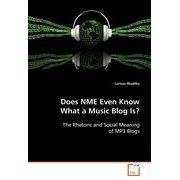
Through life's strange twists and online accessibility, my MA thesis, Does NME Even Know What a Music Blog Is?: The Rhetoric and Social Meaning of MP3 Blogs (see earlier post), is now available as a book published by VDM Publishing. That's the good news. The perhaps not-as-good news is the fact it is priced at $64 US - I have officially become a part of the artificially inflated academic book market. Currently, the only place where it actually appears to be in stock is on Amazon US and Target, and is listed, but not yet in stock on Amazon UK and Amazon Germany. I definitely don't intend to get rich from this, but at least it feels like I didn't sacrifice a chunk of my sanity for nothing, and I still feel the current technological climate of the music industry and its counterpart of music journalism is a fascinating area that needs far more exploration, academic and otherwise. It's exciting to think that I've contributed in some way to this global dialogue, especially since I couldn't find any secondary academic sources about MP3 blogs when I was researching. It's funny how, as a child, I always imagined my first published book would be a novel - then again, I also thought I'd grow up to be both a scientist and an artist.

At any rate, this will likely be the first and last time you'll find me tooting my own horn, so to speak. I'd much rather promote other people, which I suppose I did inadvertently in the book as I used numerous examples from MP3 blogs and their aggregators. However, as I tended to argue in the book, promoting others really comes down to some sort of self-promotion anyway. I'm ready to go back to the more imperceptible kind.

Monday, October 13, 2008

The Dark Stuff: Why Do We Love It So Much?


On February 1, 1995, Richey Edwards checked out of the London hotel he was staying at with James Dean Bradfield and effectively disappeared. Two weeks later, Edwards' Vauxhall Cavalier was found abandoned at the Severn View service station, but his body has never been discovered. It's a story that's taken on mythological status, not only among Manics fans, but among music fans in general. Is it because he just vanished? Or because of his self-conscious genius and brilliant creation of the Manics' ethos? Or because he's yet another tale of tragic self-destruction? I think it's a potent combination of all three that elevates him into such a rock star status. Apparently, rock 'n roll is, at its core, a risky lifestyle of testing limits both physically and mentally while pushing creative boundaries at the same time. At least that's the conclusion I come to after reading The Dark Stuff, a book that collects several of Nick Kent's pieces on specific musicians, who are generally considered self-destructive geniuses.

Kent's subjects include Brian Wilson, Jerry Lee Lewis, Syd Barrett, Neil Young, Kurt Cobain, Iggy Pop, Roy Orbison, Prince, and many others. In fact, not all are geniuses, but more in the iconic camp (ie: Sid Vicious). (However, all are male, which may speak to the historical male-domination of rock music or to Kent's own biases - I'm not sure.) Of course Kent's style is a mixture of elevated, verbose descriptions, which evoke both the magical and real, and the down-to-earth criticism you would be capable of if you had lived with these "rock stars" for their daily lives. In his introduction, Kent states that this book should serve as a "warts-and-all celebration of the driving essence that is rock 'n roll," and that it explores the "triumvirate of ego, drug abuse, and self-absorption that preys so relentlessly on the creative mind." And he's right about these three factors and geniuses of any type. What made me start thinking was how interested music fans are in people like this. I know I'm interested because I set aside all other books while reading this one cover to cover in a few nights.

I once read that the reason Sylvia Plath's work was so signifcant, and why the works of other manic-depressives were also significant, was the fact she was able to experience the absolute extremes of human emotion and then describe them aptly. The average person has a much smaller range of human experience - sometimes they're sad and sometimes they're happy, but neither of these poles take hold of them and alter their mental state so totally. Perhaps the reason I (and others) am fascinated with music idols like Iggy Pop, Syd Barrett and even Brian Jones is because I feel like they all might have been mad in one way or another, and madness is one of those anomalies in society that can be taken as either threatening and undesirable or as special and superhuman. The ideas of what madness means has changed over time from rather non-threatening to an abominable deviation to problems with brain chemistry, thus the ways of dealing with madness have shifted from allowing mad people to roam free to incarceration to now some more politically correct incarceration. I'm of the belief that, like Nietzsche's madman, crazy people sometimes have the ability to see beyond what everyone else sees, and that makes them valuable to society. It's no secret that many of the best musicians or songwriters are a little nuts, but at the same time, there are several who are iconic without being particularly talented.

Sid Vicious and Brian Jones come to mind when I think of music icons with no hugely discernible musical talent. In fact, their deaths had no effect whatsoever on their respective bands and came as no surprise to their bandmates or the world. It's like they were the epitome of living fast and dying young, and their personalities and images were so oversized that they became rock martyrs, and subsequently, the subjects of many books and films. This mythology, as Kent notes, can often be linked to the Narcissus myth - these beautiful and charming rock stars know that others admire them, and eventually they can't stop believing in their own singularity and myth nor can they stop destroying their own beauty by their tunnel vision. Being singled out as superhuman or otherworldy can play havoc with self-esteem, whether you deserve the accolades or not. Probably even more so if you don't deserve them.

What I've come to understand through Kent's book and my own observations is that artistic genius seems to go hand-in-hand with some conflicted self-image issues, meaning vanity and ego mixed with insecurity and self-doubt. This superiority/inferiority complex creates a neverending cycle of self-love and self-hate that ultimately causes a seemingly incomprehensible self-destruction: "normal" people can't understand why people who have it all - beauty, talent, success - would want to keep harming themselves and testing their limitations, often perishing in the process. Yet we all watch it like a trainwreck and pore over their life stories like scholars of the doomed. We want to put all of our hopes and insecurities onto one magical person that acts like some totem for the extremities of the human condition - someone who is more than we could ever be, someone who has the ability to tap into something beyond us. We, as humans, love myths and can't stop creating them, and so we continue to do so in the 20th and 21st centuries - these rock stars become our Greek gods and goddesses, Robin Hoods, and Gilgameshes. Their stories become both legend and parable.

Unlike the subjects of Nick Kent's book, no one knows what happened to Richey Edwards - he didn't overdose and die, he didn't blow his face off with a shotgun, he didn't take too much acid and end up languishing in his mother's house, he didn't live through trial after trial to a ripe old age of self-reflection and redemption, nor did he continue on making art, mediocre and sometimes brilliant, until a natural death. He just went missing. In many ways, he trumps them all because his genius even manifests itself in his exit. Without a body, Richey Edwards becomes both immortal and incorruptible. And like King Arthur and so many other messianic figures, he always has that potential of returning when his followers need him most.

Self-disgust is self-obsession, honey, and I do as I please. - Faster, Manic Street Preachers

Such beautiful dignity in self-abuse. - 4st 7lb, Manic Street Preachers

Paint It Black - The Rolling Stones

Archives of Pain - Manic Street Preachers